
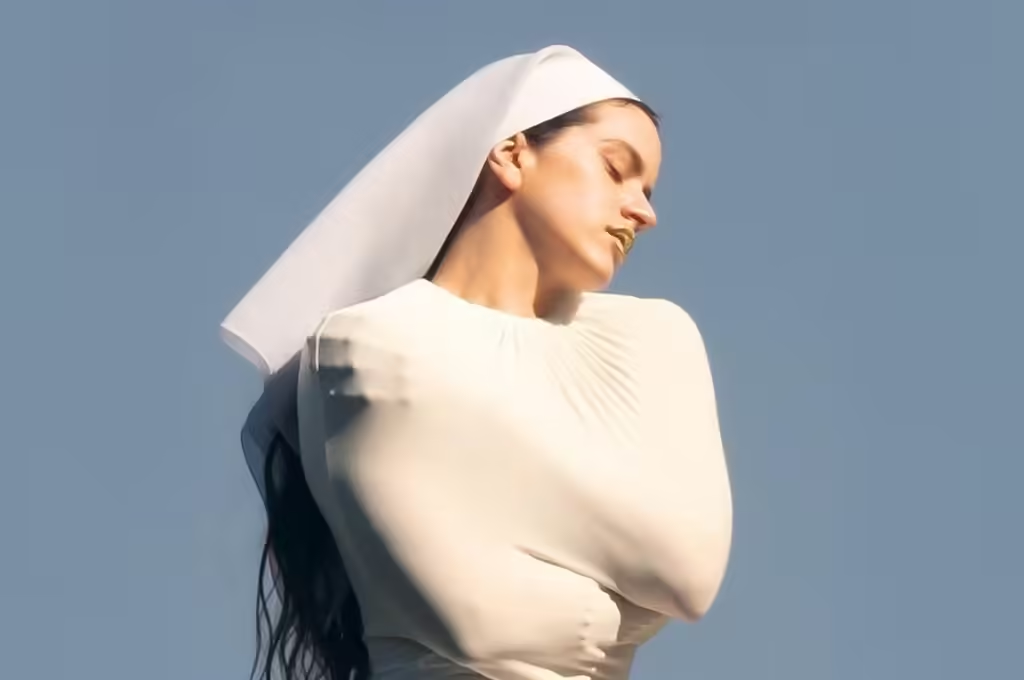
Lux is a wildly ambitious album: Rosalía sings in 13 different languages, weaves together orchestration, and explores spiritual themes by relating them to her own life. She told NPR that she wanted to “fit the entire world in an album”, and I think she managed to do just that.
Over the past eight years, Rosalía has cemented herself as a pillar of Spanish pop. Her last album, “Motomami”, dominated the Latin Grammy awards, and left me wondering how she could possibly top it. I’m usually against comparing albums in an artists’ discography (why pit two queens against each other?), but in this case, I think it’s necessary. On “Lux”, she takes the experimentation she mastered on “Motomami” and elevates it, by pairing her electronic-leaning style with orchestral compositions recorded with the London Symphony Orchestra, creating a new sound that sounds as if it’s descended straight from the heavens to bless us all. She describes the album as being “anchored in ideas of ‘feminine mysticism, taking inspiration from female saints and how they navigated “love, lust and mortality”.
The album opens with “Sexo, Violencia, y Llentas”, where light, frantic piano notes give way to echoing vocals that make it feel like she’s actually performing live on a stage. Buzzing electronics transition into a larger-than-life choir, only to dwindle back again into a ballad. Rolling drums spill seamlessly into “Reliquia”, one of the most vulnerable moments on the record, as she confesses, “But my heart has never been mine, I always give it away / Take a piece of me, keep it for when I’m gone / I’ll be your relic”. She casts herself as sacred, an object of devotion. (Also, DC mentioned).
On “Divinize”, Rosalía strains under the weight of her own longing. The imagery in the lyrics is truly gorgeous: “Each vertebra reveals a mystery / Pray on my spine, it’s a rosary”. Wavering piano and drums mirror her vocals, but the true highlight is in the outro, where a winding synth underscores a breathtaking string arrangement. “Porcelana” continues this interplay between vocals and strings, with sweeping violins answering her voice before the floor drops out into an uneasy electronic section. Dougie F’s repeated “I know you’re scared / Scared, scared, scared” lands like a warning, with deep, billowy drums ringing throughout his and Rosalía’s verses. The uneasiness eventually washes away with flamenco handclapping and a glowing choir.
“Mio Cristo Piange Diamanti”, sung entirely in Italian, is one of the purest showcases of her voice. The instrumentation takes a step back here for most of the duration of the song, and even as the song rises in its final orchestral swell, she sounds weightless.
The chaotic intro of “Berghain” perfectly sets the scene for the song, as rushed German vocals struggle to keep pace with the instrumental storm. Bjork cuts through the chaos, singing, “This is divine intervention” at the climax, slowing the pace momentarily before Yves Tumor shatters it with the repeated, “I’ll fuck you til you love me”, glaringly harsh juxtaposed against the classical arrangement beneath it, as sacred meets profane.
“La Perla” feels like a waltz and is delightfully petty. Rosalía giggles after the line “He’ll say it wasn’t him, it was his doppelgänger”, right before a cymbal crashes. A choir backs up her playful criticism, like loyal friends hyping her up.
“La Rumba Del Perdon” is just so fun. Flamenco handclaps make a return and kick in almost immediately. Guest vocals from Estrella Morente and Silvia Perez Cruz bring so much life into the song, especially with the chant, “Nonaino, nonaino, nonaino, nonaino, na” which is utterly infectious. There’s even a brief interlude of humming that sounds straight out of a Western movie. The blend of Flamenco and Classical elements is so effortless.
The album concludes with “Magnolias”, beginning with a soft flute as Rosalía imagines her own death. She pictures mourners tossing her magnolias as her casket is brought out at her funeral, while church bells ring and a pipe organ reverberates. A holy choir sings, “God descends and I ascеnd / We meet in the middle”, and she follows with, “Today I turn into dust / To return with them”. The music fades out instantly, feeling like a final, accepting last breath.
With “Lux”, it feels as if Rosalía has opened an entirely new realm. She’s clearly challenged herself, boldly transforming her classical influences into something entirely her own. I genuinely believe we’re witnessing something rare and monumental here, a once-in-a-lifetime experience.
