
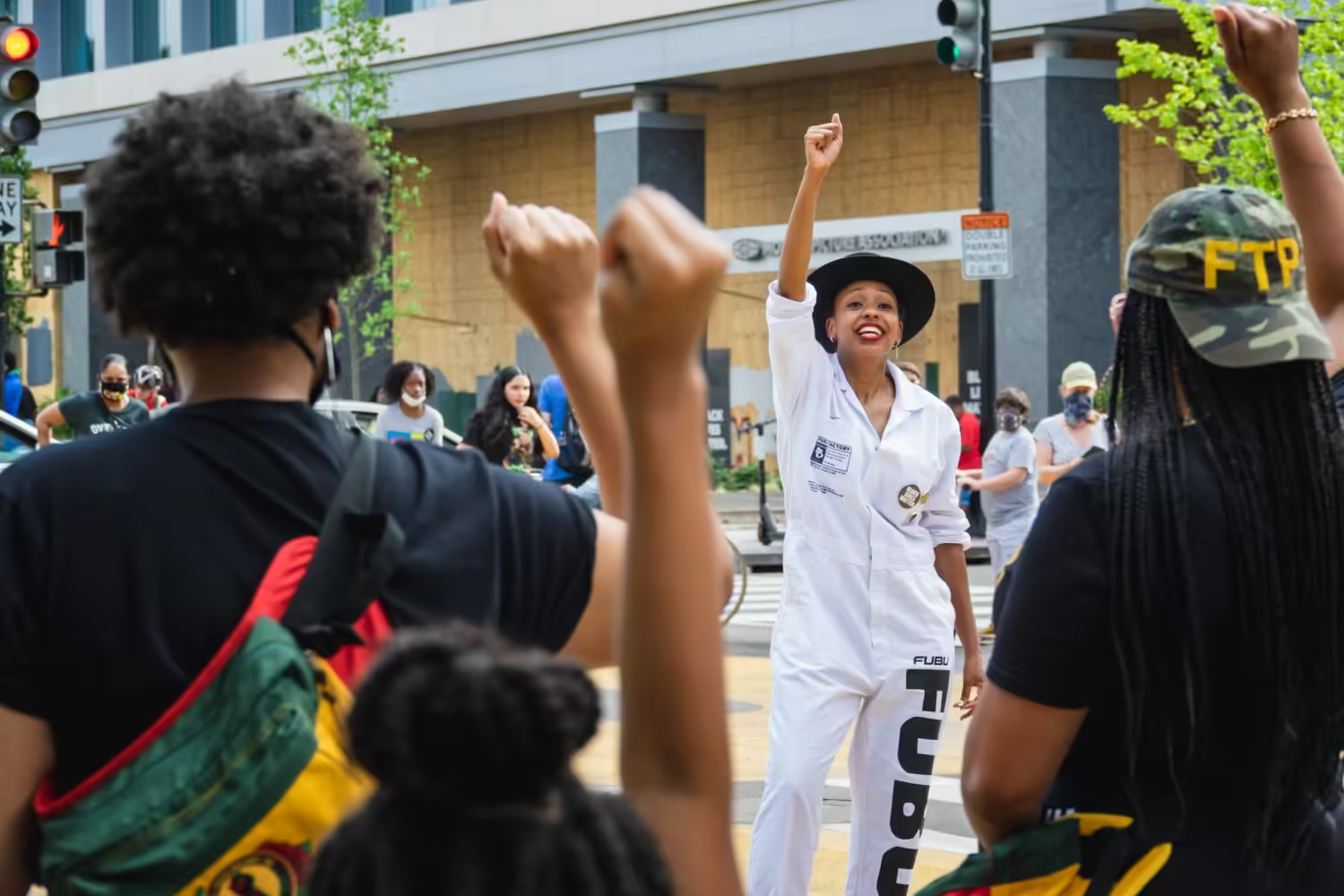
A crowd of protestors were gathered outside of Mayor Muriel Bowser’s house in 2020, calling on the city to defund the Metro Police Department (MPD) as music drifted over the crowd. In the middle stood OnRaé LaTeal, a local musician playing songs from her album “The Black Joy Experience,” when she was approached by a woman with a grant and a request. Representing Open Society Foundations (OSF), the woman asked her to create an album in support of the “defund the police” movement; instead, LaTeal formed what later became the Freedom Futures Collective (FFC).
FFC has since grown into a national creative arts incubator, bringing together young artists to engage in the fight for Black liberation and producing award-winning musical and visual projects. Its goal is to develop the next generation of “artivists” by providing artists aged 18 to 30with the resources, education, opportunities and community needed to build sustainable social justice enterprises.
“We got Breonna Taylor, Ahmaud Arbery, Elijah McClain, these Black people were being murdered, and I’m like, I gotta do something” she said. “For me, all that this was, was creating space for my young people that were in my network to be able to do the same.”
Classically trained in music from an early age, LaTeal, a DMV native, began playing saxophone and piano before transitioning into beat-making and production at Suitland High School’s Visual and Performing Arts program. After graduating from Howard University she formed the hip-hop and soul group “Aflocentric,” releasing their debut album “Libra Season: Afrocentrism” in 2014.
LaTeal, who goes by the alias “the Liberation Music Maker,” built her career around using art as a tool for collective liberation. But before she was an award-winning producer, she was a young musician grappling with the realities of systemic violence and oppression against her community.
Two years after her debut, Alton Sterling, a Black man in Baton Rouge, Louisiana, was fatally shot by police in 2016 while selling CDs outside of a convenience store.
“I don’t know what it was about that case. He just reminded me of one of my uncles. I could see my family in him,” LaTeal said “since then, I’ve dedicated my art and music to getting my people free.”
So LaTeal started showing up to what she described as “liberation spaces,” where her and fellow activists began organizing and discussing abolitionist policy, Black feminist theory and scholarly approaches to racial equity.
“I’m someone who loves political education,” LaTeal said. “I love the advocacy work that I do, I love hearing from experts and scholars and folks who are experts in racial equity and abolition and all the things. But that’s not me.”
She described her introduction to the movement as tumultuous, recalling feeling out of place and unfamiliar with the materials and concepts being discussed by her peers.
“I’m showing up, and I’m kind of like, ‘oh man, I haven’t read that book,’ or ‘I’m not familiar with that brief’ or ‘I’m not familiar with that scholar,’” she said.
That disconnect ultimately pushed LaTeal to rethink not just her own place in the movement, but how she could bring other people like her in.
She co-founded the Black Girls Handgames Project, a grassroots initiative using childhood games to foster joy and resistance, and launched Dope Creatives Only to fund other initiatives. In 2018, she produced “The Black Joy Experience” with Black Youth Project 100, a compilation of protest music and protest chants that frame joy as a form of resistance.
This became LaTeal’s sound, a mix of hip-hop, R&B and soul, combining traditional genres with chants and live footage from American protests, which she describes as “fight music.”
“It’s something that’s going to get you ready and amped up and galvanized to take action,” she said. “It’s angry, it’s rooted in joy, but there’s also an aggression to my music, because I’m not happy. I’m not happy with where we are in our country.”
Still, she said something was missing. So when LaTeal was approached by the OSF representative, she knew she had to make the most out of her opportunity.
“Music was an entryway for me, I entered the movement through music” she said. “But I didn’t feel like I was being seen fully and completely. So, I decided to create my own space.”
FCC’s first major project, “We Keep Us Safe,” brought together young DC artists to create music in direct response to police violence and the Black Lives Matter movement. But one project wasn’t enough for the artists LaTeal assembled.
From there, it evolved into a national creative incubator, offering fellowships, internships, collaborative projects and art lessons that help artists develop both their craft and their political voice.
LaTeal described the collective’s latest project, a mixtape called “Free DC,” as a “sonic response” to federal intervention and the Free DC movement through hip-hop. Many up-and-coming DC artists that helped produce the mixtape, including Reggie Volume, SONCIER The Hero, Trélogy and Ama’d, took the stage to perform some of their tracks at the March 28 No Kings Protest, hosted by Free DC.
While FFC originated as a Black liberation movement, the tape, which calls for the statehood and liberation of DC, reflected FFC’s broader fight: liberation for all.
“When Black folks is free, everybody is gonna be free,” LaTeal said. “The crux of who we are is rooted in this fight for Black liberation, but we are fighting for the liberation for all marginalized communities, for all people.”
Featured Image by Reese Bland