
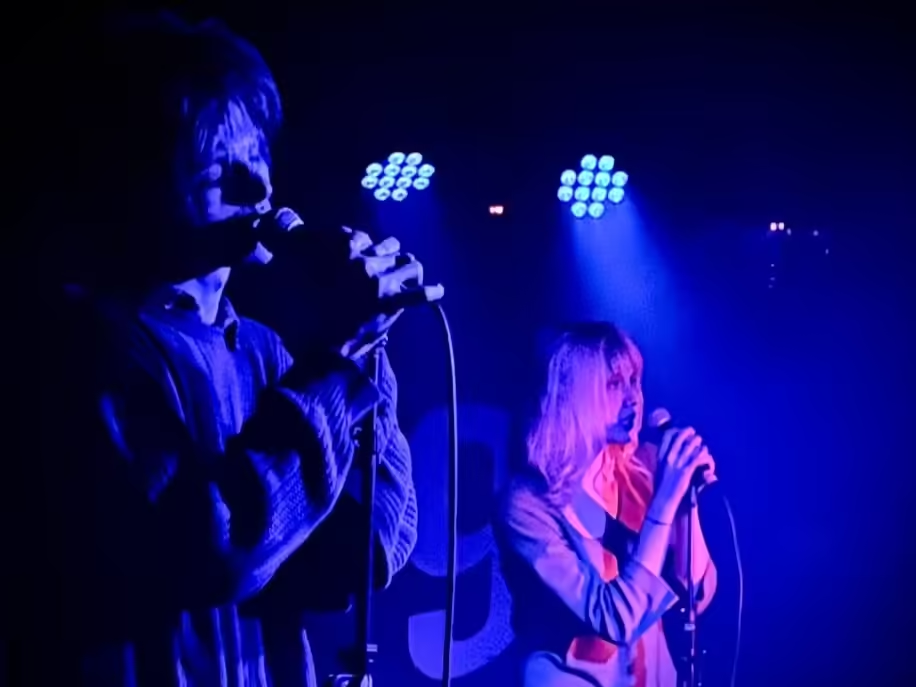
I bought my ticket to see ear at DC9 faster than I’ve ever bought a ticket to anything. It was pure instinct—the kind of instinct that tells you something matters before your brain catches up to explain you actually don’t have $20 to spend. Now, writing this three days after watching Yaelle Avtan and Jonah Paz perform in that sweaty corner of U Street on March 17th, I understand why.
ear recorded their first song, “Nerves,” on an iPhone in their library only a year ago. Twee melodies layered over digital hardcore influenced bleep-bloops. Within months, 200,000 monthly Spotify listeners. In September 2025, they released “The Most Dear and The Future”—an underrated debut album that sounds exactly like what it claims to be: the future, but also the walk home from the party, the moment you realize something in your life has changed.
If you listen to “The Most Dear and The Future,” on the surface, you’ll hear “hyperpop.” But ear is anything but surface-level. Slowed synths and reverberating bass move through their compositions organically, like they were always meant to be there. High-pitched melodies dance around them. The 808s arrive naturally. It’s all very soft, like the childhood stuffed animals you carried to college and now aren’t sure what to do with. But underneath that softness is something aggressive, something that makes your body move against your will. Square-wave synths colliding with breakbeats. Choppy, staccato production punches you in the chest. Dirty bass drops hit like you’re outside some sweaty underground club in a foreign city, coming of age in real time.
Yes, boy-girl hyperpop duos are “in” right now: Bassvictim, Snow Strippers, Frost Children. But ear is noticeably different. They lack the harsh, jagged synths of indie sleaze. Instead, it’s playful, spatial, entirely their own. Yaelle and Jonah sing in unison, meekly, about unrequited love and moving cities and unplugging from it all. About “Real Life”—the song that opens the album and names the existential dread of the A24-not-quite-a-teenager-anymore persona we so frequently imagine ourselves as.
The production is remarkably unconventional for a duo that’s only been together a year. On “Real Life,” the beats oscillate around your head, hitting heterophonically—individually in each ear—before culminating in a breakdown so beautiful it forces you to get up and move. It makes you see beauty you’d usually miss on the walk home. Or makes you realize he doesn’t love you all that much anymore. It’s a song about adulting in a world this complex, and ear writes it as it is: short, to the point, devastating.
When I arrived at DC9 about 15 minutes after doors opened, the room was already humming with a specific energy. It was a sea of twee and sweatervests—well-dressed indie kids, performative men, high schoolers, university students, a few older specimens slightly out of place at this inherently Gen Z computer music concert. The pre-show playlist they played was too good—Elliott Smith, Sparklehorse, niche stuff I couldn’t Shazam fast enough. I heard someone say they paid $145 for their ticket, which made me feel all the more justified in my “nicheness.”
 Fun fact: there’s no backstage at venues this size. Artists have to move through the crowd. I decided to position myself at the very far left of the corner stage, against the wall next to a large speaker I used as a chair between sets, hoping the artists would file off stage by passing next to me.
Then they took the stage. Opened with “Fetish,” a single released independently before their album rollout. The crowd erupted. The reverence after the track ended was remarkable—an overwhelming appreciation pouring from the room toward two college kids who looked like they might disappear if the moment got any more intense. After each song, people screamed and cheered. And after each song, Yaelle and Jonah got bashful, thanking the audience repeatedly, “I know we’ve said it a lot already, but it means so much to us. All of this means so much to us. Thank you, guys, really.”
Later, they played “Coil,” an unreleased song that incorporated organic production in ways that reminded me of SOPHIE—using masterful production to augment unlikely sounds into something beautiful. Three minutes with a MacBook and two voices. It shows a new direction for the duo, much more experimental.
After that it was all highlights. “Real Life” had the whole room singing along and moving. The way the duo danced was so uniquely them—a pulsing, thrashing, metronomic torso movement, bent at the hip, combined with aggressive melody centered headbanging, clutching the mic stand like it was a rope descending into darkness. The title track, “The Most Dear and The Future,” brought a full micro-mosh to the floor behind me.
What struck me most was the phones. There were surprisingly few. Digicams, Nintendo 3DSs, and Fujifilm automatics galore—but most people just let their bodies move along. Each person undulating and thrashing to the 808 cacophony.
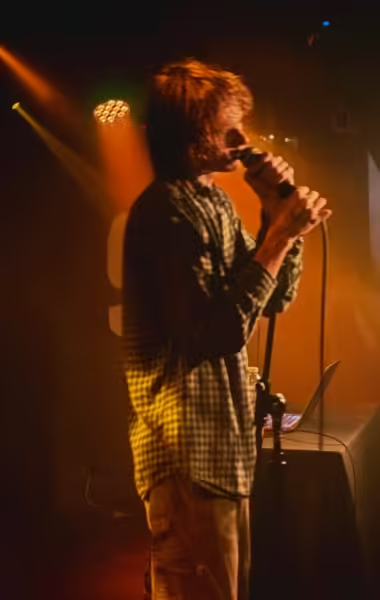
They had planned to end with their debut song, “Nerves.” But the crowd was too persistent, demanding one more song. So, they gave something better: another unreleased track, this one they’d never played live before. Organic, like “Coil”, but harder, almost industrial. After the track played out, they thanked the audience a final time before turning and walking down the side of the room, right where I was standing. I quickly professed my enjoyment of the show and asked them to “drop that pre-show playlist,” to which they chuckled lightly and continued walking. Still, a win in my book.
I could spend the rest of this article describing every technical choice they made, every moment the room broke into pulsating dance during the show. But that isn’t the point.
We’re living through a moment where 20-year-olds in basements and college libraries are deciding the future of music, where an iPhone and a vision can change everything in under a year. Where the internet—memes, samples, references—is the actual language we use to express what it feels like to be alive right now. ear doesn’t just speak that language; they’re archivists of it, preserving that specific 2010s internet sensibility—the melancholic hyperpop, the twee earnestness, the bedroom-producer DIY ethos.
I want you to go listen to “The Most Dear and The Future.” I want you to listen to it while walking somewhere familiar, maybe in the evening. Feel the beat. Move in time. Listen. Be real. Feel it all. Breathe.
Then go to a show. Sit in the corner. Watch the crowd. Feel the moment. That’s what I witnessed on March 17th. Two 20-year-olds from New York standing in a corner of U Street, nervous and bashful, while the room cheered on. It’s electric.
ear says: Sit outside the party. Be the main character of your own life, because you are. No one else is living for you. Don’t be a prick about it, but be cool. Think you’re cool because you are. And maybe daydream a bit. Romanticize the city. Romanticize that failed situationship. This is your Real Life, and it’s all so very beautiful.
ear, you really are The Most Dear and The Future of music.
All images courtesy of Lincoln Beihl