
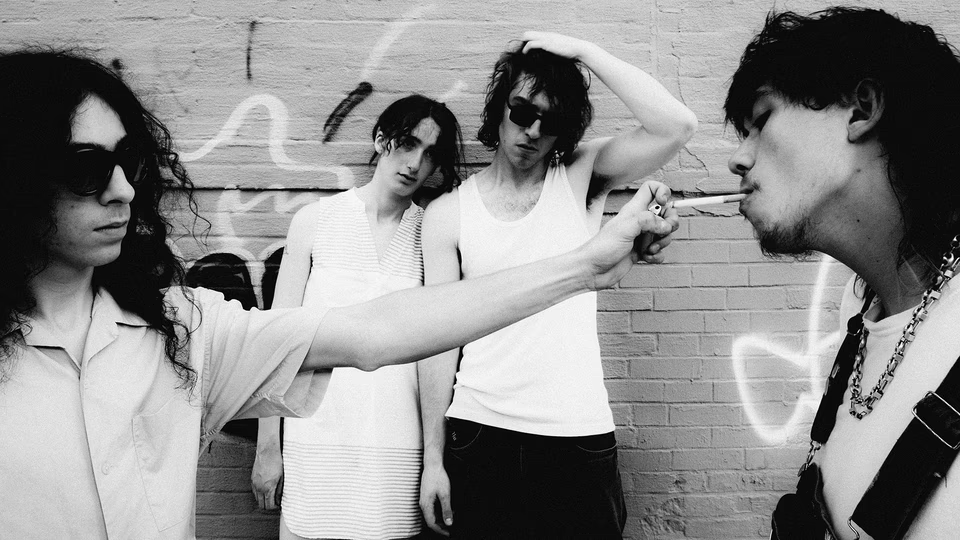
If you consider yourself even somewhat tapped into the music world, chances are you’ve heard of a band called Geese.
Born out of the Park Slope neighborhood in Brooklyn, the band consists of Cameron Winter (vocalist), Max Bassin (drums), Emily Green (guitar), and Dom DiGesu (bass). Together, the group has been releasing music for about five years. Within that, a string of three projects have been released in 2021’s “Projector”, 2023’s “3D Country”, and 2025’s “Getting Killed” – all of which received a plethora of critical success, building a cult following within the indie rock scene.
“Getting Killed” in particular has set the music scene ablaze. Everyone is talking about Geese.
With that has come a fair share of critics and lots of people unable to understand the hype, some of whom have thrown the term “industry plant” into the mix. One of the band’s loudest critics came out recently, though, with WIRED releasing an article titled “The Fanfare Around the Band Geese Was Actually a Psyop”. Naturally, heads were turned and opinions were formed, so here is my own refute to the claim.
The term psy-op stems from the phrase used for “psychological operation”, where the government builds a series of propaganda to sway the emotions of the general public. WIRED links this term to the marketing tactics used by the band, who paid an agency by the name of Chaotic Good Projects to create a series of burner accounts that would drive Geese’s music into the social media algorithm. In the coming days, the band would face haters in an attack on the marketing strategy they employed over the course of their three projects. As one writer on Substack wrote, “If 100 people think your song sucks, Chaotic Good will create 200 people that think your song is awesome”.
But what about the success? Is it fabricated? Does Pitchfork really like it? Does Anthony Fantano truly think they are the next big thing?
Reviews cannot be fabricated – social media prevalence doesn’t equate to critical success. If we lived in a world where the indie music scene relied on its messaging traveling through the sphere of TikTok or Instagram, the face of music would be Sombr (that thought alone is horrifying). It wouldn’t be Geese, as they have just two songs that have truly transcended into the mainstream (“Taxes” and “Au Pays Du Cocaine”), and even if they were a product of Chaotic Good’s marketing strategies, the music is still a product of the band.
People aren’t attracted to Geese because of their prevalence in the pop culture sphere, and even if they were, their marketing strategies to attract mainstream listeners aren’t exactly working. People like Geese because they are something refreshing. In an era where music struggles to stretch the norms and defy the boundaries, Geese have built a discography that does the opposite.
This goes beyond their most recent full-length LP, too. Their debut project “Projector” built the grounds for non-conformity and “3D Country” expanded on that. I could write another five pages on the instrumentation, which is probably the best of any band right now, and the songwriting on all three projects. The world the band has built has become a space for music listeners to feel something. You’re just as likely to shed a tear as you are to mosh in your room (or wherever you may be listening) when you’re listening to a Geese record, and that’s what makes them special. Listeners are tired of things that sound the same, and whether it be the deep, funky nature of Winter’s voice or Green’s beautiful riffs, no two Geese tracks sound the exact same. That’s why it feels like the true mainstream hasn’t necessarily received them yet.
My point is that music doesn’t rely on the basis of mainstream listeners and it certainly does not rely on social media. If a band didn’t use social media to its advantage, they’d be idiots. Music is a business and people tend to forget that. It’s a business that thrives off the engagement of people, especially those who aren’t active listeners of said music. The days where bands would sell CDs on the streets and hang flyers on every lamp post are gone. In the digital era, a band has to simply post on Instagram, and to get that traction, you can employ media strategies like Geese did.
I will say, I do think that the ability to employ these marketing strategies is advantageous. Having a company like Chaotic Good there to bolster your online presence is huge, but people don’t stick around if the music sucks. Geese have built a catalogue strong enough to maintain streamers. People don’t like it because it’s online, they like it because it makes them feel something. I don’t disagree that the band got lucky and was able to afford the service of Chaotic Good because it’s true, a lot of awesome bands can’t (which sucks). But having the budget to afford the ability to market well online doesn’t make the band a “psy-op”
It’s time that music listeners (and now magazines, too) stop labeling everything that sees a large rise in popularity as being an “industry plant”. The phrase is just an insult to throw at anything you don’t understand. Maybe take the time to digest the art and form a real opinion on it, even if you don’t like it. Calling something a “psyop” or “industry plant” is just an easy way out to discount anything you don’t enjoy or you haven’t listened to. The music is real, it’s incredible, and I’m excited to see the music industry’s favorite psy-op thrive in the years to come.