

The reaction to the music video for “Stateside” by PinkPantheress, featuring Zara Larsson, had me thinking: are we in a new era for music videos?
After its release, I saw a complete wealth of fan edits, commentary, and clips of the video circulating on my TikTok “For You” Page. It felt like an event. As someone who grew up treating music videos with the same fervor as one would a sports game, this was especially exciting to me. In recent years, music videos haven’t seemed to occupy the same space they once did in the cultural zeitgeist. Maybe it’s nostalgia blindsiding me, but it does feel like the general consensus. What used to be one of the most anticipated parts of an album cycle has lately been viewed as more of a label obligation, often burdensome on the artists and teams that have to make them with little return on investment.
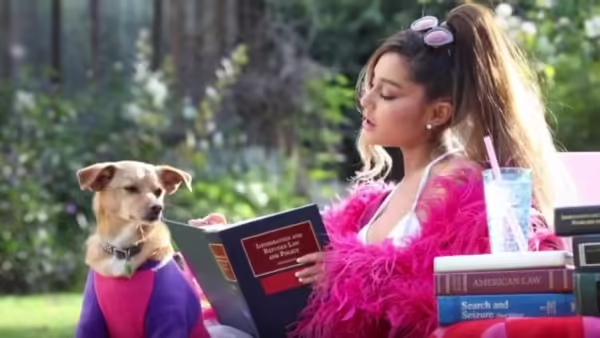
From Ariana Grande’s “thank u, next”
At first, the dwindling relevance of music videos seems strange. Our culture is arguably more visually dominated than it’s ever been, with short-form, visual-first platforms shaping the way we consume literally everything. Theoretically, a medium designed especially to cater to the visual cortex should be bigger than ever right now.
When MTV launched in 1981, it completely redefined the music video and what a pop star really was. Prior to that, music videos were largely just concert footage relegated to late-night TV, rarely seen outside that capacity. MTV transformed the medium into a mandatory limb of the musical experience, yielding the cinematic sprawl of Michael Jackson’s “Thriller” and the rotoscoped masterpiece that is A-Ha’s “Take on Me”. Music videos like these functioned as standalone artistic statements rather than just advertisements for their records.

From Michael Jackson’s “Thriller”
The mid-90s pivot to reality programming signaled the beginning of the end, a decline that culminated in December 2025, when MTV’s lingering 24/7 music channels were shuttered for good. The growing presence of the internet and social media has shattered what was once a collective gaze on the biggest voices in music. Instead of watching one big thing together, we watch a million smaller things in isolation.
Furthermore, our eroded attention spans have made it so that we’d much prefer to watch a 15-second edit of the most visually arresting frames of a music video we didn’t watch than commit to watching the full three-and-a-half minutes. The result of this attention model is an era of visualizers (essentially lower effort music videos) and lyric videos that exist purely to be played in the background while we fold clothes, study, or scroll. It’s no longer necessary for artists to create videos for songs when fans are already attributing visuals to their songs through edits and trends.
Even in the midst of what looks like a death for the medium, I would argue instead that it’s actually a revival. Precisely because the music video is no longer a mandatory element of the promotional cycle, it’s being liberated to become an optional artistic statement.
Take Sabrina Carpenter. Across her recent albums, she has treated her videos as an expansion of her cinematic universe, whether she’s vying with Jenna Ortega for the affection of the same man in “Taste”, or leaning into a 70s aesthetic on “Manchild”. Similarly, Addison Rae’s “Headphones On” provided the image of her riding a horse across a dreamy mountainscape, pink hair trailing behind. In “Rush” by Troye Sivan, the focal point is a mesmerizing dance that perfectly mirrors the song’s kinetic, sensual energy. Each of these artists utilize the music video as a seamless extension of their brand in their own unique ways: story, moodboard-like imagery, or choreography, creating mental sticky notes that resurface every time you hear their names.

From Addison Rae’s “Headphones On”
This brings us back to “Stateside”. The song didn’t hit number one on the Billboard Hot 100 by accident. Released in October of 2025, it only reached the top of the charts just over a week ago, roughly two months after the video dropped. Between Pink’s regally-touched Y2K aesthetic and Larsson’s beachy Lisa Frank glitter explosion, the video builds a world worth living in and dissecting a hundred times over. It’s become a genuine cultural moment, extending beyond the screen and into the dance routine of Alysa Liu at an Olympic gala earlier this year.
This trend in intentionality with music videos has to be partially indebted to K-pop, a genre that has long treated choreography, styling, and lore as equally important to the music itself. K-pop is no doubt influencing Western artists to do the same, further spreading through international acts like KATSEYE.

From Red Velvet’s “Russian Roulette”
The music video is thriving and more important than ever precisely because it is no longer necessary. “Good Luck Babe” by Chappell Roan became a hit without a video, allowing the song to stand entirely on its own while reserving visual storytelling for Roan’s other songs, like “Subway.” Artists actually having the choice makes the videos that do get made feel more deliberate. We’re probably never going to see a return to the MTV heyday of music videos, but in trading off cultural dominance, we’re potentially getting something better. For the first time in decades, the music video feels like it’s being used to say something, rather than just sell something.