
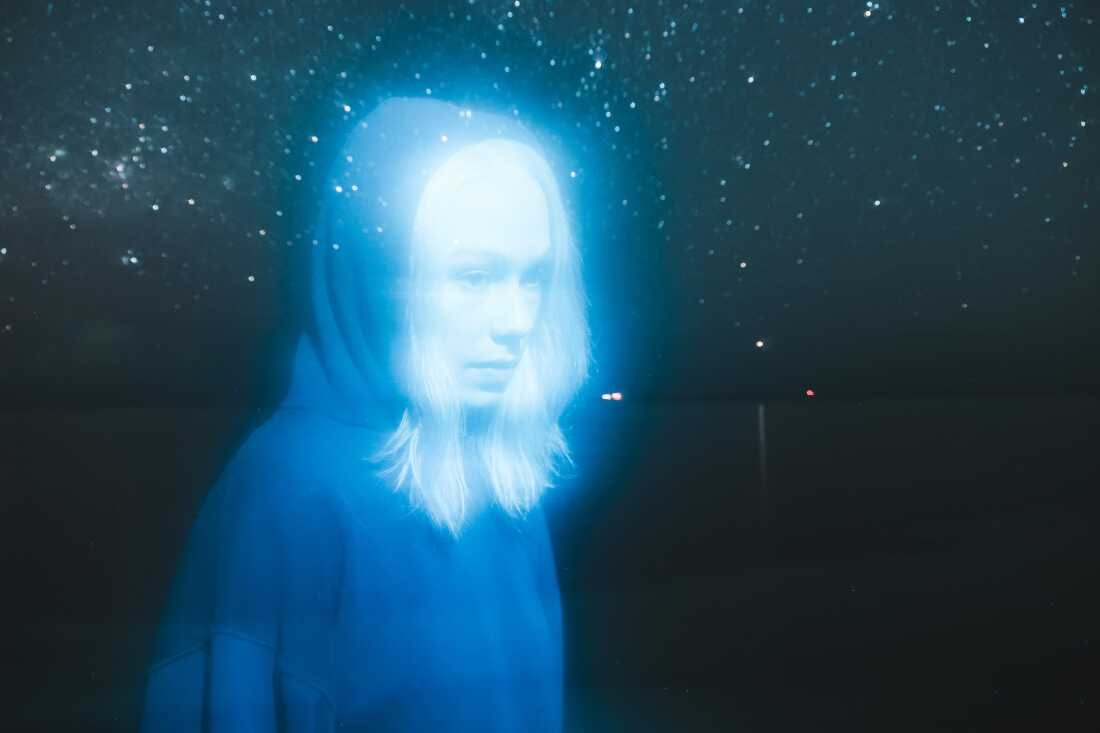
Her sophomore album, Punisher, grew a cult following that began to stretch to the mainstream. That indie label she amassed from her debut album, Stranger in the Alps, was gone. Following Punisher, Bridgers toured the album, opened for Taylor Swift, and reconnected with her band boygenius (who would later be nominated for and win multiple Grammys).
But following the indefinite hiatus between her and her band in early 2024, it was radio silence from Bridgers. Fans worried for her well-being—it was clear that to create the music she makes, it had to have created a sense of sadness. Her father had passed away a year prior, and she had broken up with Paul Mescal a year before that. Was Phoebe Bridgers okay?
The next two years intensified the worries. Fans had accepted that new music might never come. That all changed when an Instagram story from the singer’s mom surfaced in January of 2026, hinting at a potential return within the year, but still, silence from Phoebe. That being until early May of this year. A surprise show in Roswell, New Mexico. 400 people. No phones.
That trend continued throughout the month of May, with Bridgers performing a series of intimate, phone-less shows throughout portions of the south and midwest. Concertgoers relayed that she was playing new music, just her and an acoustic guitar. Lines reached thousands of people for each show, with most venues capping out at just a few hundred people. People posted pop-up show merch on eBay, tried to find ways to record the new material, and went feral over the smallest details of the unreleased tracks—Phoebe Bridgers had only performed for a few thousand people and it was the most talked about element of her career ever. Eventually, it came around to the biggest show of her career—a $1 concert at New York City’s Madison Square Garden, where she shared news of a new tour.
The Lost Tour was announced, stretching from mid-September to mid-December, with almost every show selling out instantly. Joined in Europe by former Black Country, New Road lead Isaac Wood and indie darling and Lost Weekend frequent Alex G in North America, the world was ready to see Phoebe live. But still, no new album announced.
On June 24, that changed. Lost Weekend was announced, and its only single, “Lost Boys,” was released the following day. It seemed like the whole music world was sitting on the edge of their seats waiting to see what Bridgers was about to do. She was the biggest name in the singer-songwriter space, but had yet to fully branch out.
“Lost Boys” blew up. Its fusion of folk, rock, and singer-songwriter musicianship was a hit. The way it built up and crashed down in the final third was something fans knew from Phoebe—it felt like an addition to her hit “Kyoto”. But some were skeptical; it was a familiar territory for Bridgers, something that felt like she had done it. However, it is quite the contrary when it comes to this new album.
Lost Weekend is an exploration of the time she spent away from the spotlight. It explores the different corners of music. Bridgers dabbles in electronic, alt-country, rock, ambient, and of course, singer-songwriter elements. On this project, she takes the criticisms and flips the metaphorical music bird to anyone who said she only made music that sounds the same. Gone is the Punisher era of quiet, indie folk songs with destructive lyricism — Lost Weekend is a mixed bag of introspection on how Phoebe Bridgers will continue to go on.
The intro track, “The Outside,” lets you know that this is no longer just a singer-songwriter record. Phoebe Bridgers is here to bare it all, and she doesn’t care how she does it. When the record first hits the ear, it almost feels like you may have mistakenly turned on Bon Iver’s 22, A Million with the way the vocoder hits the ear and chops up Bridgers’ typically smooth voice. As she hides her voice behind the electronic elements, she discusses her father’s funeral before falling into a storyline following the feelings she carries with fame and performing live.
In terms of the work Bridgers puts in here sonically—the record is incredible, and it is refreshing. Punisher was a step in the right direction, but Lost Weekend is a mile in the right direction. When you’re confused, it ropes you into thinking it is the same folk music she made all along, but when you think you’ve figured it out, she throws a wild curveball that allows the mind to run wild on where she may go next.
The third track, “Kill Me”, brings you to the doorstep of Punisher. “Kill Me” invites the listener in—it’s familiar, the Phoebe Bridgers we are used to. You sit down, she casually mentions how her fellow boygenius members are getting married and how she herself is falling in love, singing softly. At moments it feels like the Punisher title track or “Chinese Satellite”, but before you know it the snares fold into a rapidly evolving instrumental and the harmonies of Son-John Johnson (pseudonym of the Geese lead, Cameron Winter) take over. Just when you had it figured out, that very folk structure is destroyed into a cultish sense of chanting—Phoebe screams, and the deepness of Winter’s voice haunts.
The collaboration between the two is a massive highlight of Lost Weekend. In the short span of the two songs Winter is featured on, he provides two extremely different services vocally. On the track “I Can’t Wait”, he ditches that haunting sense for a beautiful duet, crooning with Bridgers. They sing about Bridgers accepting the different parts of herself, while the song floats through a banjo instrumental, taking over the relatively ambient sounds that surge with anticipation in the first half of the track.
“I Can’t Wait” is a great fit for the latter half; it culminates a lot of what the record is about sonically. At times, it feels like a mesh of every song, paying honor to the fact that every song is extremely singular within the context of Lost Weekend.
Her love ballad to Bo Burnham, “Bobby,” fools you into thinking it could be an homage to mid-60s psychedelia, donning early bagpipes and sitars. Her halfway track, “Panorama,” leaves the ear at ease, providing listeners with a Radiohead-esque sense of ambience and instrumentals. Her song “Other Plans” creates a sense of sadness, toning itself down and letting Phoebe whisper into the ear in her classic fashion. Her boygenius reunion on “Haunted” makes you want to kick your feet up and down and lock arms before spinning around and around, all while she lays it all out concerning breaking up with Mescal and returning to the band in 2022.
When looking at it, it’s clear that Phoebe has loved and lost and everything in between. She is in love, but throughout the course of her time away she’s had some complicated feelings. One of those being said break-up with Paul Mescal. Her track “The Governor’s Waltz” elaborates upon their relationship the most, making it clear that throughout the course of their time together, Phoebe experienced a fair share of her own worries and insecurities.
Her planetarium listening experience, which I was lucky enough to experience, put an interesting image in fans’ heads. As Bridgers begins to sing, you see a goose fly throughout the sky, flapping it’s wings through a course of objects, landing upon a mirror. As the mirror disappears, she says things like “You deserved better, you wanted me” and “I’m next to you, you’re next to nothing.” While the production layers itself in a sense of whimsy and almost fairytale-like piano keys, she bares it all.
As she comes to the end of the chorus’ second edition, she leaves a subliminal, “You promised you would never leave me / But maybe you’ll do it for me.” Floating through the bridge, Phoebe leaves her remarks about Gracie Abrams (Mescal’s now girlfriend) before detailing how her feelings have faded. Hinting at the aforementioned lyric, she approaches the final seconds and says “Do it for me” before ending the track subtly (which is a rarity throughout the album).
Another thing that Bridgers wants to discuss with the listener is the loss of her father. Some of her best writing comes at the hands of discussing the complicated nature of her relationship with her late dad. At times, she wants to miss him, but at others, she is eerily okay with him being gone. When it isn’t guilt, it is acceptance, but ultimately it is growth and the second half of the record puts that on display. Phoebe strays away from talking about being in love and transitions into her relationship with her father.
When “Panorama” fades, what could be argued as her best writing ever, “Still Standing”, approaches. She seemingly discusses the abuse her mother experienced from her dad, “I found her bleeding over the sink / But when you said sorry / You looked at me,” noting that when her dad knows he did something wrong, he doesn’t acknowledge her mother. Continuing to evaluate that moment, she realizes that she was accustomed to the behavior, then she talks to her dad saying, “I can’t imagine you dead / But you are every day / Thank you for everything.”
On “Never Going Back!”, she repeatedly says how the past is completely different from the present and that she can’t return. As the banjo and drums fade, Phoebe lets out a playful scream, before an old voice memo from her dad comes in—“Hey Phoebe, it’s your dad. Uh, I know you’re busy. Being a rockstar takes up a lot of your time I’m guessing.”
It’s clear the passing of her father is confusing, but Phoebe isn’t afraid to let the listener know that, in fact, she almost encourages them to ask questions.
The listener is left wondering how Phoebe truly feels, and that thought only intensifies when the record comes to an end on “Lost Weekend (Reprise),” a seeming remembrance of her father. She talks about knowing he can’t come back, but she remembers him. She remembers things like how he told her, “The government isn’t trying to kill you / They just don’t care if they kill you.” But when it’s all said and done, she knows he is gone. As the final moments of the record approach, the listener has it figured out.
Bridgers spent the last six years experiencing an odd sense of grief. The end of the song approaches; she says a few final remarks.
“But if I ever come out of hiding / You won’t have to find me again”
She closes out the second verse and the ambience picks up. She harmonizes, and the sound of the needle picks up. The record is over and the six-year wait with it.
Lost Weekend is a beautiful record that flourishes within its flaws. Phoebe Bridgers branches out and remains vulnerable when discussing the deepest happenings of the last half-decade. When she isn’t singing, she lets the instrumentals tell you how she feels—when she sings about being in love, she delivers the word with an energetic, noisy rock sound—when she recalls the worst of her family memories, she does it silently. The record is a mixed bag that thrives on freeing itself from the singer-songwriter exclusive label she was once left with. It’s impressive how much Phoebe Bridgers has matured, and what’s even more impressive is her ability to improve with every record. Here is to hoping we don’t have to wait another six years to hear the next one