
I remember sitting in bed at 2:30 in the morning, glued to my phone a little over halfway through my sophomore year of high school.
That night (or morning, if you may) was Frank Ocean’s first live performance in six years: Coachella 2023. But little did people who weren’t at the festival know that he would pull his performance from their YouTube channel live stream, remove parts of his set last minute, and show up an hour and a half late. Viewers and Frank fans, like myself, were left to scour the internet through the means of Instagram and TikTok live just to get a glimpse of what Coachella-goers were seeing.
I watched Instagram Live as the lights died down and the murmurs of the annoyed crowd turned into a quiet excitement. The spaced-out synths of his breakout single “Novacane” broke the silence – out walked Frank and the show began. A little over an hour later, his show ended and his set had been highlighted by his tardiness and his disengagement from the crowd, but also the unspoken, unexplainable beauty that the performance exuded.
From the dark, yet colorful visuals throughout the performance to a setlist that capitalized on his emotional range, there was no shortage of discussion following that very performance. Was this to be expected from such a mysterious artist? Or was this a level of disregard that his fans couldn’t even come to defend?
Along that six year span of no live performances, Ocean had released a string of singles teasing a new album. Songs like “In My Room” and “Moon River” highlighted that very rollout that all pointed towards a 2020 release of an album titled “Look At Us, We’re In Love”, but before its release, Frank’s brother tragically died in a car crash. This was followed by an understandable radio silence from Frank Ocean, so when it was announced that he would headline Sunday of Coachella, fans were met with surprise and excitement.
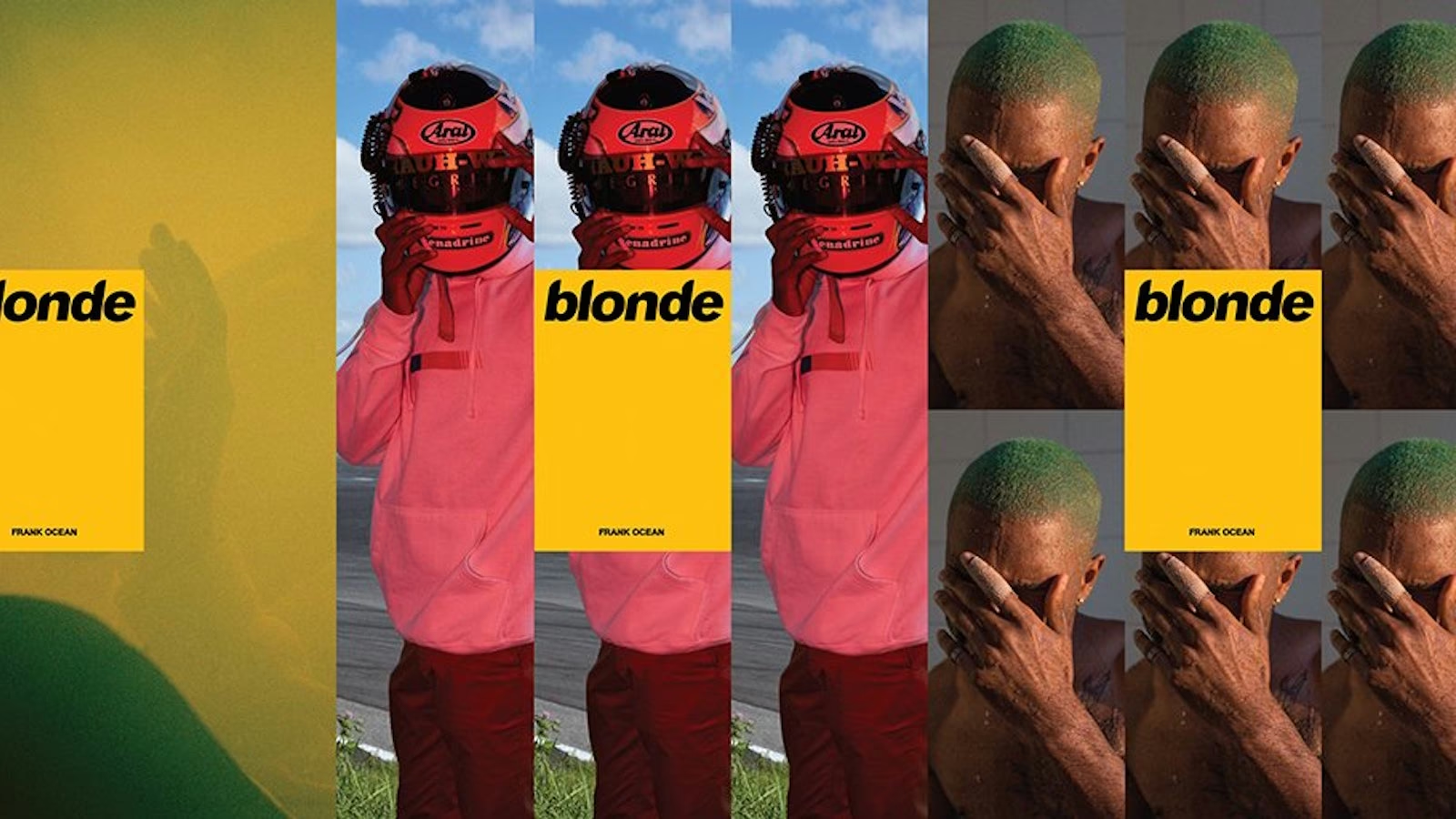
A large portion of these fans came from his 2016 release, “Blonde”, which is now a certified platinum record, but also one of the most highly regarded albums of all time. As a matter of fact, it is my favorite album ever, so when I came up with the idea for a column named “Carter’s Classics”, there was no way I was not reviewing it.
“Blonde” was released in August of 2016 under Frank’s own independent label, Boys Don’t Cry. It followed the release of his visual album “Endless”, which was dropped by Frank as a way to fulfill his two-album clause with Def Jam Records. Fans were disappointed with “Endless” – it felt like an incomplete record, but when the release of “Blonde” caught everyone off guard the next day, it all made sense.
The shock-release of “Blonde” turned music fans on their heads, Frank Ocean had finessed the music industry. “Blonde” was what the fans wanted.
The album sets itself up as a drug-infused trip down memory lane, where he reflects on romance and youth, in particular. Songs like “Nikes” and “Futura Free” discuss his past, while songs like “Ivy” and “Self Control” inject the album with a sense of love and loss.
“Nikes” is the opening track of “Blonde”, which boasts a pitched-up, autotuned vocal performance throughout the beginning half of the track. Frank uses this time to bluntly look back on his relationships that were built on the basis of materialism, so much so that the very first line of the entire album is “these bitches want Nikes”. Following the bold first half of the track, he tones himself down and, using a more natural tone, professes his love for the protagonist in his love story. With this, the album builds itself that space of romantic nostalgia that it lives within for the entirety of its hour-long run time.
By the time the five minutes of “Nikes” is over, the listener is able to grasp where Frank wants to take Blonde. He lends his musical influences just as much to the ambient sounds of Aphex Twin as to the soulful vibe of Sade, which creates a sense of individuality to his discography.
Progressing to the second track, you’re hit by the emotional, unavoidable brick wall that is “Ivy”. “Ivy” is Frank at his best – it’s a simple track that is beautifully written, pacing itself out with moments for Frank’s vocal range to shine (it also has my favorite lyric of his: “If I could see through walls I would see you fakin’, if you could see my thoughts you would see our faces”). The first two tracks on “Blonde” are as good as it gets, but it extends further throughout the project.
“Ivy” is followed by his most-streamed track, “Pink + White”, where he discusses mortality and the difficulties of dealing with Hurricane Katrina, before hitting listeners with the first of four interludes. “Be Yourself” introduces the theme of drugs to the album, where we get to hear Frank’s mom tell him to avoid drugs in college, where he then ignores her orders in the following track, “Solo”. In “Solo”, we see Frank try drugs and alcohol as a means of escapism to the things he begins to struggle with at the start of the album. He uses “solo” and “so low” as a homophone, firstly saying he should go “solo”, until he follows it up by saying he feels “so low”.
Once “Solo” ends, he gives us the high point of the entire album in “Self Control”.
“Self Control” is the type of song that changes lives and I really mean that. It is a combination of everything that is good in music – it is a simple, emotional love ballad that is extremely intimate in every sense of the word. In moments, “Self Control” feels singer-songwriter, in others it feels like gospel, but at its core it’s a track that dives into the loss of innocence and the intricacies of love.
Eventually, we arrive at “Nights”, which serves as the halfway marker of the album. The track is split by a beat switch, with the first half being the euphoria of the drugs and the second half being the crash. Once Frank crashes, he spirals, which is reflected throughout the second half of the album. The first full track that follows “Nights” is the drug-induced chaos of “Pretty Sweet” that sounds like a chaotic rush of emotion entangled with a series of reverbed vocals and drums. This is all before Frank takes full flight in the last minute of the track, cutting off immediately into another interlude.
Approaching the end, “Blonde” hits an iconic stride to end the project.
“White Ferrari” provides a melancholic look at young love, using his deepest lyricism to relay messages of longing and self-worth. The track has etched itself as one of Gen Z’s favorite “depression songs” for that exact reason, since it provides a sense of transparency and relatability that a lot of tracks don’t provide younger audiences. “Siegfried”, the next track, builds upon this with its trippy imagery that builds into Frank’s love letter to one of the first men he loved. Using the Elliott Smith “fond farewell” line, he builds into a trippy ballad that unfolds into the stripped-down “Godspeed”. “Godspeed” ends the storyline on a note of renewal and understanding, coming to terms with the fact that “there will be mountains you won’t move”. Paired with the soul of church organs, Frank begins to clear up following his high, and “Godspeed” is proof of that.
“Futura Free”, the final track, is a culmination of everything Frank discusses on “Blonde”. It’s the recollection of what he did to be here – the struggles of Katrina he talks about on “Pink + White”, the battles with substances he discusses on “Solo”, the love he explores on “Ivy” and “Self Control”.
“You could change this track now, could’ve changed this bitch a long time ago”, he closes out by saying, before the track turns into a lost tape of a four-minute interview with Frank’s brother, Ryan Breux.
Ryan tells us that he thinks the most beautiful thing he has ever witnessed is “friendship and how it controls the world”.
Those are some of the last words on the entire project and it makes me think about the ways this project has impacted me. It’s been my favorite album since my freshman year of high school and in a way, it has become a part of who I am. It’s the reason why I stayed up until 3 a.m. just to get a glimpse at a live Frank Ocean performance and the reason why I fell in love with music.